Most people treat foreign coins like pocket clutter. They come back from a trip, toss a handful of euros or pesos into a dish on the dresser, and forget about them entirely.
That turns out to be a mistake. A growing number of foreign coins, many of them relatively recent, have appreciated well beyond their face value, and collectors in 2026 are paying real money for pieces that once circulated through ordinary hands.
1. The 1996 Canadian Toonie, First-Year Issues and Error Varieties

Canada introduced its two-dollar coin, the “Toonie”, on February 19, 1996, replacing the $2 banknote. As a first-year bimetallic coin, the 1996 issue quickly attracted collector attention, and certain error varieties have become genuinely valuable.
The most dramatic errors involve the aluminum-bronze inner core separating from or misaligning within the nickel outer ring; severe rotated-core examples have sold for $50 to $500+ CAD depending on the degree of misalignment, while a missing-core example can exceed $1,000 CAD.
The highest verified auction record for any toonie, a 1996 “Beaded” variety graded AU-55 by PCGS, reached $5,400 CAD at Alliance Coin & Banknote in September 2021. Common circulated toonies of any year remain worth face value, but high-grade and error examples reward careful searching.
2. Pre-Euro German 2 Deutsche Mark Coins, The Politicians Series

Not all pre-euro German coins are worth chasing, but the “politicians series” of 2 Deutsche Mark coins, produced from 1969 through the early 1990s and featuring portraits of figures including Kurt Schumacher, Konrad Adenauer, Theodor Heuss, Ludwig Erhard, Willy Brandt, and Franz Josef Strauß, has developed a steady collector following.
The series replaced an earlier Max Planck design that had been demonetized in 1973. Each denomination was struck at five mints (Berlin, Munich, Stuttgart, Karlsruhe, and Hamburg, identified by mintmarks A, D, F, G, and J respectively), and lower-mintage year-and-mint combinations attract the most interest.
Well-preserved proof examples from sealed mint sets can reach meaningful premiums among European collectors. Germany’s history gives this coinage a cultural weight that other pre-euro series don’t always carry.
3. The 2000 Australian “Incuse Flag” Millennium 50 Cent

Australia marked the new millennium, not the Sydney Olympics, with a special 50-cent piece in 2000. A scarce production variant exists in which the flag detail on the coin’s reverse was struck incuse (recessed) rather than in relief.
The Royal Australian Mint confirmed that approximately 200,000 of this variety were produced, likely from a single die. No incuse flag coins are known in mint sets; they entered general circulation, making them findable in change, but rare.
Circulated examples in average condition sell for around $20–$100 AUD depending on grade, while high-grade mint-state examples certified by PCGS (MS62 and above) have sold for significantly more at Australian numismatic auctions. The coin is widely regarded as Australia’s rarest circulating 50-cent piece.
4. The British 1985 Britannia 50 Pence

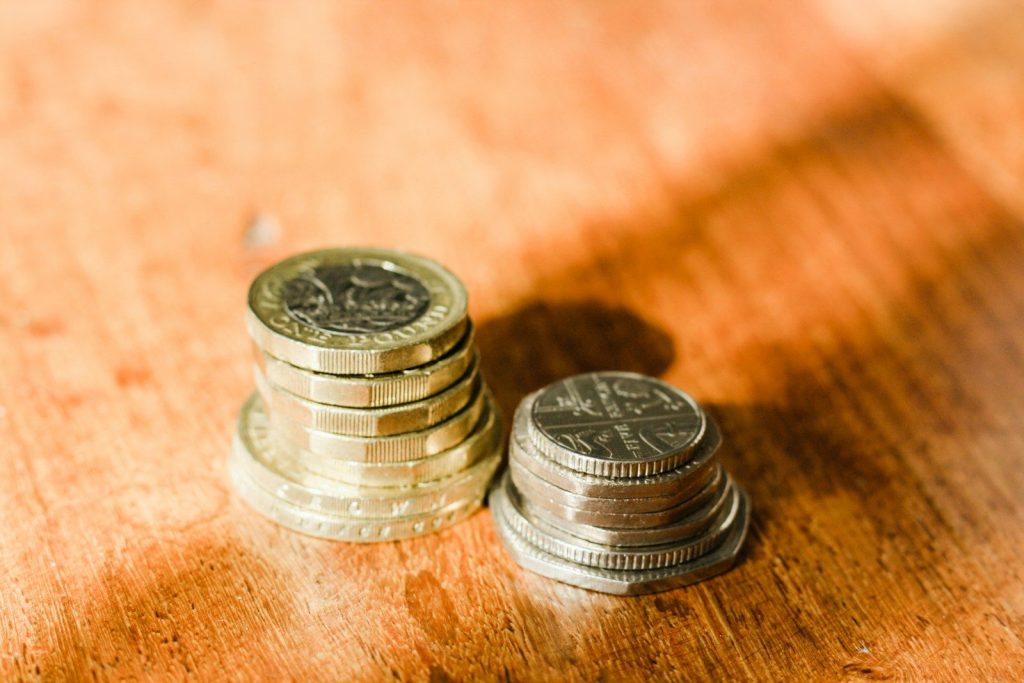
The British 50p, introduced in 1969, was the world’s first seven-sided equilateral curve heptagonal coin. Its constant-width shape allowed it to roll smoothly in vending machines, making it both distinctive and practical.
While most years of the large-format 50p (1969–1994) are common, the 1985 Britannia issue stands apart: only 682,103 were minted, far below the tens of millions typical of other years. A circulated 1985 50p commands around £1–£3, but uncirculated examples from sealed Royal Mint sets can fetch £10 or more, and certified gem-uncirculated pieces are considerably rarer.
The coin was withdrawn from circulation in 1998 when the smaller 50p replaced it, so examples are no longer entering circulation. The 1985 date is the one to watch for when sorting through pre-1997 decimal change.
5. Hong Kong $5 Coins Before the Bauhinia Series (Pre-1993)

Hong Kong’s coinage carried the effigy of Queen Elizabeth II from the 1860s until 1992. From January 1993 onward, the Monetary Authority gradually replaced the existing range with a new series bearing the bauhinia flower.
The $10 denomination was an entirely new coin introduced with the bauhinia series in November 1994, no Queen’s effigy $10 coin had ever existed. Collector interest therefore centres on the pre-1993 Queen Elizabeth series in denominations up to $5, particularly the earlier portrait varieties.
Over 585 million Queen’s effigy coins were withdrawn as part of this replacement programme, though they technically remain legal tender. Outside Hong Kong, these coins are often underpriced, which makes them worth examining at estate sales in cities with large diaspora communities.
6. The Irish Millennium Punt (2000)

Ireland issued a special one-punt circulating commemorative coin in 2000 to mark the millennium, the last Irish pound coin to be minted before the country switched to euro coins in 2002. Designed by Alan Ardiff and Garrett Stokes, it featured the Broighter boat on the reverse.
The coin was issued in two versions: a circulation strike with a mintage of approximately 5,000,000, and a proof version in a smaller quantity. Production of Irish pound coins ceased in September 2000, meaning the Millennium punt was the final chapter of Ireland’s decimal coin history.
Uncirculated examples are not scarce in the millions sense, but high-grade certified coins and proof versions carry real premiums among Irish and Irish-American collectors for whom the piece carries emotional significance as the end of an era.
7. Mexican 100 Peso Coins, Earthquake-Era Context (1985–1986)

The catastrophic September 1985 earthquake devastated Mexico City, causing widespread infrastructure damage. The Casa de Moneda de México continued operating, though the event created a period of significant disruption.
Mexican numismatists have documented error varieties on 100-peso coins from this era, including die cracks and striking anomalies, consistent with the production pressures of the period. Top-grade documented error specimens from 1985–1986 have reached several thousand pesos at specialist auction, with demand from collectors who focus on the social and historical context of Mexican coinage.
Confirming an authentic error requires comparison with reference specimens; consult published Mexican numismatic guides before attributing a variety.
8. Pre-Handover Hong Kong $5 Coins, The Earlier Portrait Series

The pre-1993 Hong Kong $5 coins offer an accessible entry point for collectors. The series ran from 1976, with a redesign in 1980 and a portrait change in 1985 when Raphael Maklouf’s effigy of Queen Elizabeth II replaced the earlier Arnold Machin portrait.
These portrait-change transition years, particularly the scarcer-mintage issues from the Maklouf portrait run before bauhinia replacement, reward careful attention. Well-preserved examples in original mint luster trade well at Hong Kong auctions and are frequently undervalued at estate sales elsewhere.
What to Do If You Think You Have One

Before sending anything to auction, get a third-party grade. PCGS and NGC both handle foreign coins, and a certified grade protects the value and makes the coin far easier to sell.
Error coins especially benefit from professional authentication, since some varieties are contested and a seller without documentation will almost always leave money on the table. The market for foreign coins has matured enough that raw, ungraded pieces from private sellers are treated with skepticism. Take the extra step.